Introduction
For wedding decorators, tent houses and banquet teams, working out how much fabric for ceiling draping is one of the first numbers needed for a quotation, and one of the easiest to get wrong. Order short, and the site team runs out of two panels before the ceiling is finished. Order heavy, and the extra metres sit in the godown, eating into your margin. A dependable estimate comes down to four venue measurements, the draping style and the roll width of the fabric. Businesses planning larger purchases can also explore Vmore Fabrics’ guide on how to select the best event fabric manufacturer for bulk orders.
Why Ceiling Fabric Estimates Often Go Wrong
Most shortfalls do not come from wrong measurements. They come from treating a draped ceiling as a flat surface. A hall that measures 30 metres long needs more than 30 metres per panel, because every swag dips, every end needs a tie-off and every pleat folds fabric back on itself.
Roll width is the second common cause. A 3 metre roll and a 1.5 metre roll cover very different areas, yet site teams sometimes order metres without confirming which width the quotation is based on. Any fabric calculation for wedding ceiling work should begin by confirming the roll width with your supplier.
Four Measurements to Take Before You Calculate
Ceiling Length
Measure the side along which the panels will run. Panels usually follow the longer side of the venue because this reduces the number of joins.
Ceiling Width
This is the distance the panels must cover side by side. It decides how many panels you will need.
Swag Allowance
If the fabric dips between support points, add 10 to 15 percent to the length. Tight, tented panels need closer to 5 percent.
End Allowance
Keep about 0.5 metre at each end of a panel for tying, clamping or tucking into the frame. Small mandaps usually need only 0.3 metre per end. If the venue shares measurements in feet, multiply by 0.3048 to convert them. A 100 foot hall is about 30.5 metres long.

Fullness is how much extra fabric is gathered into the space a panel covers. A flat panel uses fabric at 1x. A pleated panel gathers twice the fabric into the same space, so it covers only half its roll width. This single factor changes your total ceiling draping metres more than anything else.
A practical fullness guide by draping style:
- Flat or tightly tented panels: 1x to 1.2x
- Soft swags with gentle gathers: 1.5x
- Pleated ceilings with fan clusters: 2x
- Ruffled domes and heavy clusters: 2.5x to 3x
Quote the style before the metres. When clients see that a ruffled dome needs more fabric than a flat ceiling, the price difference becomes easy to explain.
Count the Panels
Panels = Ceiling width ÷ (Roll width ÷ Fullness). Always round up to the next whole number. Half a panel is still a full panel when you are standing on the ladder.
Find the Length of Each Panel
Panel length = Ceiling length × (1 + Swag allowance) + End allowance for both ends.
Calculate the Total Order
Total = Panels × Panel length. Then add 10 percent for wastage, joins and on-site changes. This works as a simple ceiling drape fabric calculator that any site supervisor can run on a phone.
The table below applies the formula to three venues decorators handle every season.
| Venue | Size | Roll width | Style and fullness | Panels | Length per panel | Total with 10% extra |
|---|---|---|---|---|---|---|
|
Banquet hall |
30 m × 15 m (approx. 100 ft × 50 ft) |
3 m |
Pleated, 2x, 15% swag |
10 |
35.5 m |
About 390 m |
|
Lawn pandal tent |
18.3 m × 12.2 m (60 ft × 40 ft) |
3 m |
Soft swag, 1.5x, 15% swag |
7 |
22 m |
About 170 m |
|
Wedding mandap |
3.6 m × 3.6 m (approx. 12 ft × 12 ft) |
1.5 m |
Ruffled, 2.5x, 10% swag |
6 |
4.6 m |
About 30 m |
In the banquet hall, a 3 metre roll at 2x fullness covers 1.5 metres of width, so a 15 metre wide ceiling needs 10 panels. Each panel is 30 × 1.15 = 34.5 metres, plus 1 metre for both ends, giving 35.5 metres. Ten panels make 355 metres, and the 10 percent buffer brings the order to about 390 metres.
Getting the Mandap Ceiling Fabric Quantity Right
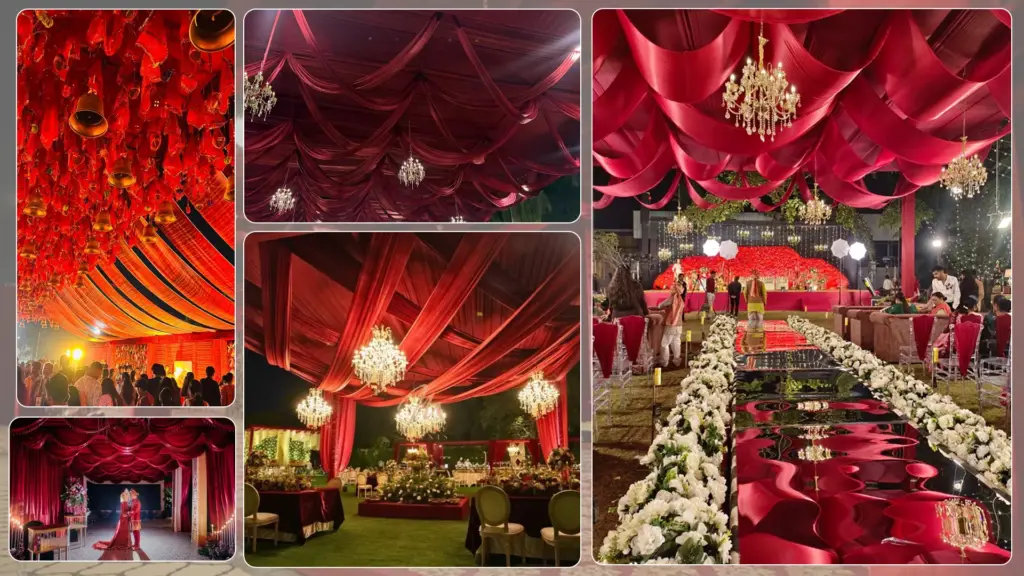
Mandaps deserve extra attention because they sit at the centre of nearly every wedding photograph. The ceiling is small, so it is often underestimated, yet it usually carries the heaviest styling in the venue. When planning your mandap ceiling fabric quantity, calculate any frilled border separately. Measure the perimeter, multiply it by the frill fullness and add it to the total. A 3.6 metre square mandap has a perimeter of 14.4 metres, so a 2x frill needs close to 29 metres of strip fabric on top of the ceiling itself.
For starburst or radial designs, the panel length is the distance from the centre to the farthest corner, plus swag. Mock up one section before cutting the full set.
Practical Ways to Reduce Fabric Wastage
Order the complete ceiling from one dye lot. Two batches of the same colour can look different under stage lights, and the camera notices it immediately. Keep a record of every venue you drape, because those measurements become a ready template for the next booking at the same hall. If you run a rental inventory, choose fabric built for repeated use so its cost is spread across many events. For a wider purchasing checklist, decorators can also review Vmore Fabrics’ article on common mistakes to avoid when buying event fabric in bulk.
Planning Ceiling Fabric With Vmore Event Fabric
Vmore Event Fabric has supplied event and wedding fabrics from Surat for over 35 years. Its SkyCouture collection offers 16 ready ceiling designs, from soft swags such as Coral Mist to ruffled domes such as Velvet Rosette, each with its own fullness and fabric requirement. Share your venue length, width and chosen design to receive the exact metres and a bulk quotation.
Conclusion
Knowing how much fabric for ceiling draping a venue needs protects both your timeline and your margin. Measure the length and width, confirm the roll width, choose the fullness for the draping style, apply the three-step formula and keep a 10 percent buffer.
Frequently asked questions
With a 3 metre roll, pleated at 2x fullness, a hall of this size needs about 390 metres, including a 10 percent buffer.
Fullness is the ratio of fabric used to the space it covers. A flat panel is 1x, while a pleated panel is 2x and needs twice the fabric.
Add around 10 percent to the calculated total to cover wastage, joins and on-site design changes.
Wider rolls, such as 3 metres, reduce joins on large ceilings. Narrower rolls are easier to handle on small mandaps and detailed designs.