Introduction
For event planners, exhibition companies, decorators, and branding agencies, selecting an event fabric manufacturer in Surat can directly affect display quality, project timelines, and overall sourcing efficiency. Event fabrics need to balance appearance, durability, handling, printing performance, and commercial requirements. Buyers therefore need more than a basic supplier list; they need to understand fabric specifications, applications, manufacturing capabilities, and quality considerations before placing bulk fabric orders. For related sourcing insights, businesses can also explore Vmore Fabrics’ guide on choosing an event fabric supplier.
What Is Event Fabric for B2B Applications?
Event fabric refers to textile materials used for temporary or semi-permanent visual installations such as exhibition backdrops, stage décor, booth displays, banners, promotional structures, and branded environments. Depending on the application, buyers may require lightweight polyester, stretch fabrics, printable textiles, or fabrics with specific drape and finishing characteristics.
Unlike ordinary apparel or home-textile materials, event fabrics are often selected according to installation requirements. Weight, width, surface texture, opacity, dimensional stability, color performance, and print compatibility can influence how effectively a fabric performs at an event. For B2B buyers, consistency between samples and bulk production is equally important because large projects may require repeated quantities across multiple locations.
Types of Event Fabrics Used for Commercial Projects
Polyester event fabric is widely considered for applications where lightweight handling, printability, and easy installation are important. It can be suitable for backdrops, promotional graphics, booth displays, and other visual applications. The appropriate construction and finishing depend on whether the fabric will be stretched, hung, framed, or used as a printed surface.
Stretch and lycra fabrics are commonly used when a fitted or flexible appearance is required. Their elasticity can help create smooth visual surfaces around structures and frames. For exhibition and promotional environments, stretch materials can provide a clean branded finish while remaining relatively easy to handle and transport.
Printed event fabrics are another important category. Dye-sublimation and other textile printing methods may be used depending on the fabric construction and desired visual result. Buyers should confirm whether the selected material is compatible with their printing process before approving a large order.
Exhibition fabric suppliers generally offer materials in different weights, widths, finishes, and compositions. The right option depends on the structure, lighting conditions, installation method, required print quality, and expected frequency of use.
Exhibitions and trade shows are among the most demanding applications because fabrics must create a professional visual environment while remaining practical to install and transport. Back walls, booth graphics, hanging displays, counters, partitions, and decorative elements may all require different textile characteristics.
Corporate events and brand activations often prioritize color reproduction, visual consistency, and customization. A branded environment may use printed fabric for stage backgrounds, photo walls, promotional structures, or product presentation areas. In these cases, fabric performance becomes part of the overall brand experience.
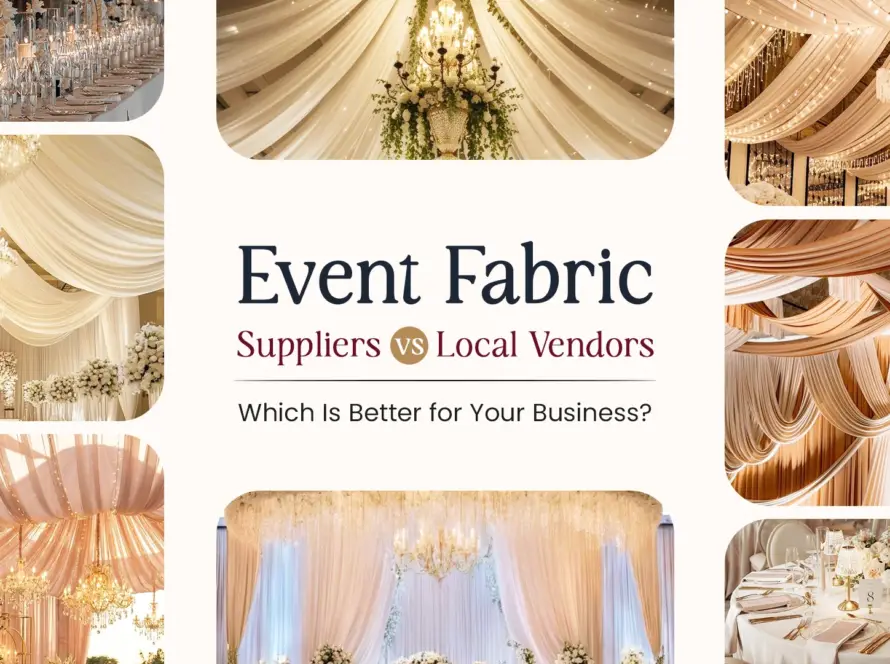
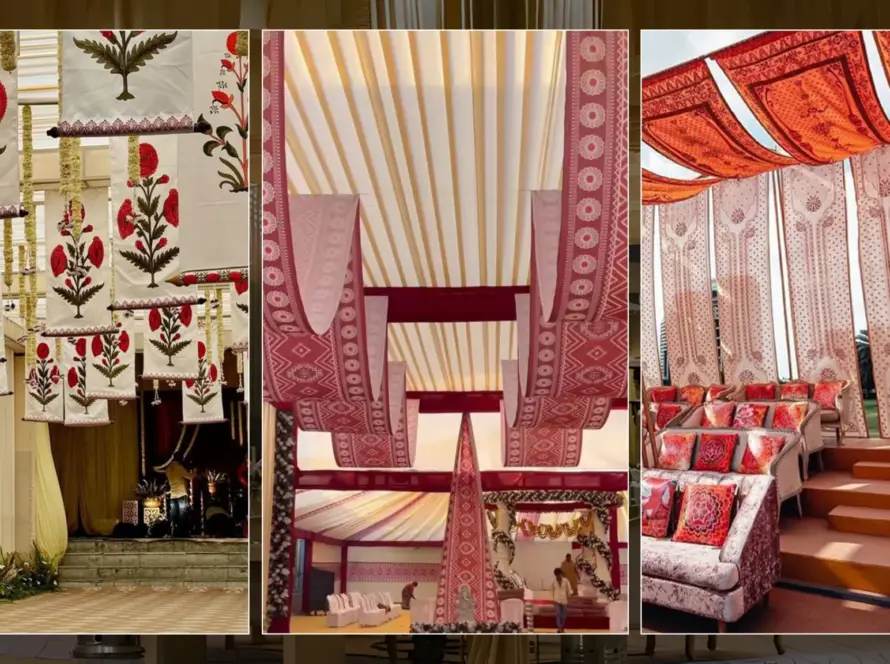
Wedding and event decoration can involve draping, ceiling installations, stage backgrounds, entrance décor, and decorative partitions. Here, softness, fall, texture, opacity, and color availability may be more important than printing performance.
Hotels, banquet venues, retail spaces, and promotional installations can also use event textiles for temporary campaigns or recurring décor. For these projects, buyers may prioritize repeat availability and consistent specifications so that future orders match earlier installations.
Why Surat Is Important for Event Fabric Manufacturing
Surat has a well established textile manufacturing ecosystem covering yarns, weaving, processing, dyeing, printing, finishing, and fabric distribution. This industrial base creates opportunities for businesses seeking textile products for commercial applications and bulk requirements.
An event fabric manufacturer in Surat may be able to coordinate multiple stages of production or work within an established local manufacturing network. For B2B buyers, proximity to textile production and processing capabilities can simplify sampling, communication, customization, quality discussions, and repeat sourcing.
However, location alone should not be treated as proof of quality. Buyers should evaluate actual product specifications, production capability, sample consistency, quality-control practices, and order support. A reliable sourcing decision should be based on measurable requirements rather than the manufacturing location alone.
Understanding Event Fabric Specifications
Before approaching an event fabric manufacturer in Surat, buyers should define the technical requirements of the project. Fabric composition is one of the first considerations because polyester, stretch blends, and other constructions can behave differently during printing, installation, and handling.
GSM, or grams per square metre, indicates fabric weight and can influence handling, opacity, drape, and application suitability. There is no universally correct GSM for every event project. A lightweight backdrop may require a different construction from a heavy-duty display or stretch application.
Width is another practical consideration. Selecting a suitable fabric width can reduce seams and simplify installation for large-format applications. Buyers should also review surface finish, texture, dimensional stability, color fastness, and print compatibility according to the intended use.
For printed applications, buyers should assess how well the fabric accepts ink and whether the finished material provides the desired color reproduction and visual clarity. Sample testing under actual lighting and installation conditions can provide more useful information than specifications alone.
Event Fabric Manufacturing and Quality Control
A professional manufacturing workflow typically begins with understanding the buyer’s application and technical requirements. Fabric construction is then selected or produced according to the required performance characteristics. Depending on the product, subsequent stages may include dyeing, printing, finishing, inspection, rolling, and packing.
A thorough quality assessment should cover both appearance and technical performance, including consistency in GSM, width, shade, surface finish, and printing quality. For repeat projects, maintaining consistent specifications is especially important because variations can become visible when materials are installed side by side.
An event fabric manufacturer in Surat serving commercial buyers should also understand the practical requirements of display production. Fabric that performs well in a laboratory specification may still require application-based testing before it is used for a large event. Sample approval therefore provides an important checkpoint before bulk manufacturing.
For businesses focused on exhibition requirements, an event fabric supplier and manufacturer guide can provide additional context around bulk sourcing.
How to Evaluate Event Fabric Manufacturers in Surat
When comparing an event fabric manufacturer in Surat with other sourcing options, buyers should look beyond product descriptions. Manufacturing capacity, available fabric constructions, customization options, quality-control systems, sample support, and production timelines are practical indicators of B2B readiness.
A manufacturer should be able to communicate specifications clearly and provide samples that represent the material being offered for bulk production. Buyers should also establish expectations for width, GSM, composition, color, finishing, packaging, and delivery before confirming an order.
For large or recurring projects, production scalability is important. A supplier may perform well on a small sample order but struggle to maintain consistency or timelines at higher volumes. Discussing capacity and repeat-order requirements early can reduce sourcing risks.
Factors That Influence Event Fabric Pricing
Event fabric pricing depends on several variables rather than a single standard market rate. Fabric composition, GSM, width, finishing, quantity, customization, printing requirements, packaging, and logistics can all affect the final commercial quotation.
Bulk fabric orders may receive different pricing because production planning and material procurement change with volume. However, the lowest quotation is not necessarily the most economical option if it results in inconsistent quality, higher wastage, delayed delivery, or unsuitable fabric performance.
For a meaningful price comparison, B2B buyers should request quotations based on the same technical specifications. Comparing two suppliers using different GSM, widths, compositions, or finishing standards can produce misleading conclusions.
Businesses can also review Vmore Fabrics’ resource on common mistakes in bulk event fabric purchasing when developing their procurement checklist.
B2B Sourcing Process From Requirement to Bulk Order
A structured sourcing process can make procurement more predictable. Start by defining the application, required fabric type, dimensions, GSM, composition, color, printing method, quantity, and delivery schedule.
Next, approach an event fabric manufacturer in Surat or suitable event fabric suppliers in Surat and request samples or technical specifications. Evaluate the fabric according to the actual application rather than appearance alone. If printing is involved, test the material using the intended printing process.
Once the sample is approved, confirm commercial terms, production lead time, packaging, quality expectations, and delivery requirements. For recurring projects, document the approved specifications so future orders can be compared against the same reference.
This approach is particularly useful for exhibition companies, event agencies, decorators, and branding businesses managing multiple projects. A documented specification sheet can reduce misunderstandings and support consistent procurement.
Choosing Fabric According to the Event Application
The best fabric is determined by how it will be used. Exhibition displays may require lightweight, printable, and dimensionally stable textiles. Stage backdrops may prioritize width, opacity, visual appearance, and print quality. Draping applications may place greater emphasis on texture, softness, and fall.
For branded installations, color reproduction and surface appearance can be critical. For reusable event systems, durability, handling, packing, and repeat availability may carry greater importance. Discussing the final application with an event fabric manufacturer in Surat helps align fabric selection with actual project requirements.
Vmore Event Fabric and B2B Requirements
Vmore Event Fabric can be positioned as a B2B sourcing option when working with an event fabric manufacturer in Surat. Buyers can discuss their intended application, fabric specifications, customization requirements, and quantity to identify a suitable material for their project.
Rather than selecting a fabric only from a catalogue description, businesses should communicate the complete use case. This allows the manufacturer to understand whether the requirement involves exhibition graphics, stage décor, branded displays, draping, or another commercial application.
For businesses already researching manufacturer selection, the existing event fabric manufacturer selection guide can serve as a supporting resource.
Conclusion
For businesses sourcing textiles for exhibitions, corporate events, brand activations, décor, and promotional displays, selecting the right event fabric manufacturer in Surat requires a combination of technical evaluation and commercial planning. Fabric composition, GSM, width, printing compatibility, quality consistency, production capacity, and delivery requirements should all be considered before placing bulk fabric orders.
Surat’s textile ecosystem provides a strong sourcing base, and an event fabric manufacturer in Surat can be evaluated according to the buyer’s specific technical and commercial requirements. A sample-led and specification-driven procurement process can help reduce quality issues and improve consistency across recurring projects.
For businesses looking for customized and bulk event textile solutions, Vmore Event Fabric can support discussions around fabric selection, specifications, customization, and commercial requirements.